Diabolique and Columbo and Ghosts, oh my!
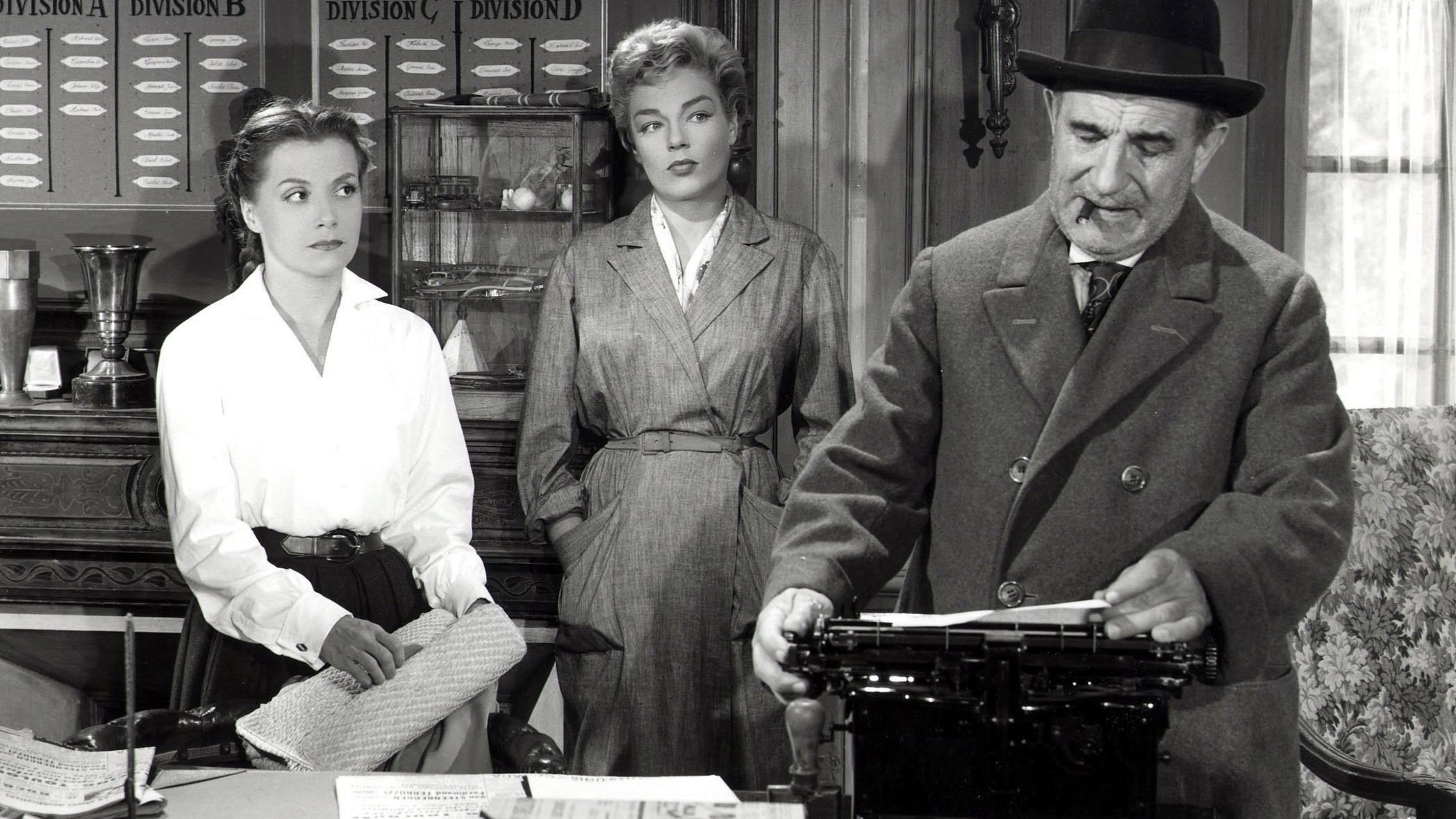
Christina, Nicole, and Alfred in Diabolique
In his 1912 collection of crime fiction short stories, R. Austin Freeman wrote what he called “an experiment, an inverted detective story in two parts” in which the first section described in great detail how the criminal committed their crime before switching perspectives to the investigator who picked up on the clues left behind during the commission of the crime (the name of the short story is “The Case of Oscar Brodski,” first published in Pearson’s Magazine). He did this, in part, to show how little people paid attention to those clues if there wasn’t somebody there pointing them out. “I calculated that the reader would be so occupied with the crime that he would overlook the evidence. And so it turned out.” Freeman invented the howcatchem, an inversion of the classic whodunnit. The idea, at least in its conception, was to show that “the reader can always be trusted to mislead himself, no matter how plainly the data are given.” I’d argue that later entries in the genre, such as the long running Columbo tv show and its spiritual successors Poker Face and Elsbeth, use the genre for other purposes. In these shows, the pleasures come from knowing that the criminal won’t get away with their dastardly deeds, that there is an almost supernatural investigator who will soon arrive to upend the perfect crime the perps think they’ve gotten away with. We watch the crimes looking for what will undo the criminals before Columbo can spot his “one more thing,” rather the opposite of what Freeman was out to prove with his experiment. Instead of getting caught up in the emotional and plotty crime being committed, viewers of howcatchems are more likely to be eagle-eyed in looking for a detail that the criminals miss but which our intrepid investigators won’t.
I started thinking about this subgenre when I watched Diabolique (Clouzot, 1955) last night. I am a fan of the three shows mentioned above, and so, when a retired police investigator who hangs out at the local morgue overhears a woman confirming that the dead body she is viewing isn’t her “missing” (aka murdered by her and her accomplice, his mistress) husband and starts to offer his services in finding him, I got excited. The woman, Christina, is a classic howcatchem villain. She’s a nervous wreck, perhaps driven to that state by her abusive husband, or maybe her devout Catholicism is to blame. Throughout the first half of the movie, the murder is committed via a careful plan executed by Christina and Nicole, the mistress. Like any good howcatchem, there are moments when the camera briefly lingers on an unnoticed puddle of blood or calls attention to the timing of the loudest plumbing imaginable, noticed by the other occupants of the hotel where the two women drown the man, Michel, in a tub. I didn’t know at this point that we would actually soon see a proto-Columbo character who might find these clues just as the film and I did. Interestingly, the movie seems to care less about them than I did. I think there’s a good reason for that.
Spoilers for the remainder of the film from here on out
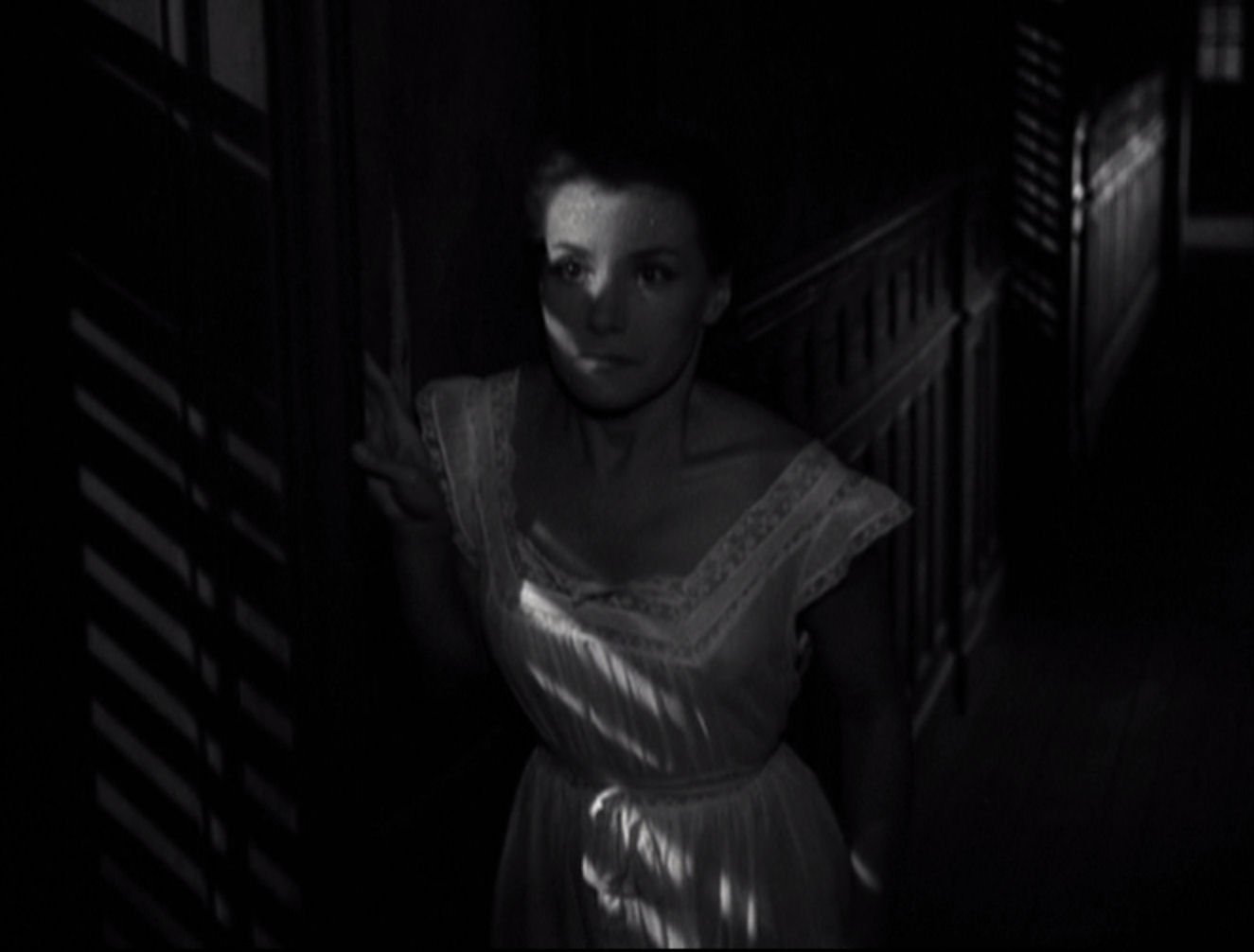
Christina, terrified and sweaty
The answer to why the film goes through the trouble of setting up a howcatchem then largely declines to care about the actual catchem part is that the howcatchem genre is a red herring of sorts. Yes, the retired detective Alfred Fichet does investigate the disappearance of Michel, but his disappearance is not your usual howcatchem crime in the first place. For one, there’s no body, despite the two murderers dropping him into the small, gross pool that sits on the school grounds long after he stopped breathing underwater the night prior. Secondly, Christina is not built for the criminal life. She almost immediately wants to confess, her guilt weighing on her weakened heart. She nearly crumbles to pieces under the lightest of questioning by Alfred upon their first meeting. Where Nicole is calm and steely in her determination to be rid of Michel for good, Christina nearly backs out at the last minute and needs encouragement up until the final moment of Michel’s life. Then she starts to see ghosts.
His ghost, specifically. It haunts the school grounds. Boys tell stories of his cruelty in nearly-spectral encounters with him. He appears in shadow in a photograph, or is it a trick of the light? But really, where did his body go? These are the kinds of questions a howcatchem can’t really contain. Howcatchems are about logic and an orderly universe that reveals the killer through a keen observer spotting something out of order. Ghosts are fundamentally out of order, an apparition that should not and could not be. So why does Diabolique include both the supernatural and the keen old man detective who puts his nose in places where criminals would rather it not be? How does it reconcile these two opposing genres?
Well, it kinda has its cake and eats it too. The film concludes with two absolute banger scenes. The first Christina’s long investigation of a shadowy figure moving through the halls of the school late at night. Is it the ghost of her husband? She darts through the school’s darkened corridors, her breath hitching from fear and her weakened heart. She stumbles into a bathroom and splashes water on her face until she turns to the tub and sees her husband’s body floating there as it did when she murdered him. Then it starts to get up and open its eyes to reveal a milky white stare and Christina falls to the floor, dead from shock and fright. So the ghost was real! It makes sense, the detective had been absent for a few scenes as the supernatural stuff started to take over the movie. The ghost story has fully supplanted the detective story.
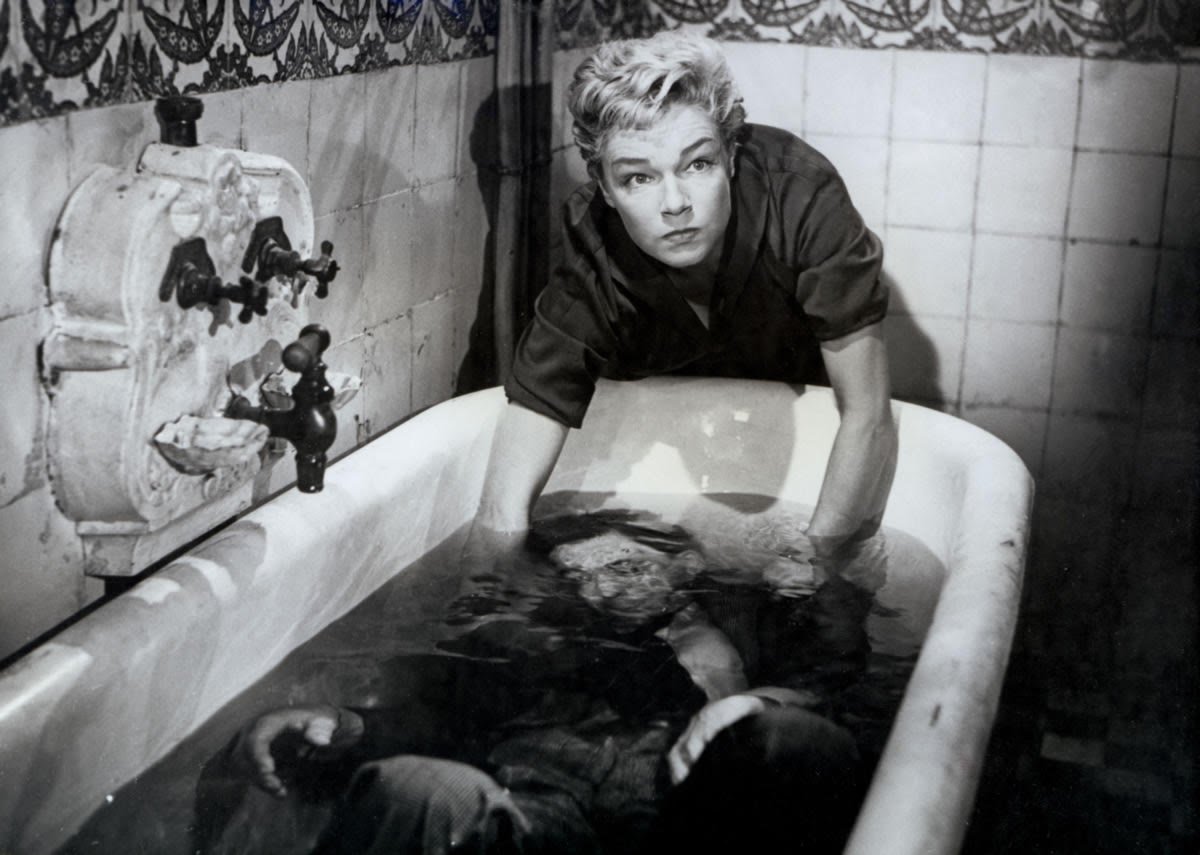
Nicole, drowning Michel
That is, until the ghoul reaches up to his eyes and takes out the full lense contacts he had in, showing just normal human eyes. Michel is just a guy. His mistress, Nicole, comes in and they embrace each other, gloating about their plan going perfectly and how they’ll take over the school to sell it for a profit now that Christina is dead. So none of it was supernatural after all! A fun twist! And look, here’s good old Alfred—who I guess had just been hanging around waiting for something to happen—ready to arrest Michel and Nicole for their murderous plot. Columbo always gets his man, even when he’s French and it’s like two decades before the start of his show.
But that’s not the end of the movie. In the last scene, the young boys at the boarding school are preparing to leave it for good. One particular young boy, who had his slingshot confiscated by Michel in the time when he was pretending to be a ghost, shoots a window out of the school building with a stone. One of the remaining teachers asks him where he got the slingshot from and the kid tells him that Christina gave it to him. It’s a wonderful little tag, a scene that again flips the genre back to the supernatural and leaves the viewer with an unsettled feeling. What to make of a movie that has switched between incompatible genres several times, especially ending with a supernatural touch after confirming that all the prior supernatural elements were part of a long con?
I’m not sure there’s a definitive answer to that question. Maybe it’s ultimately a movie about the fundamental unknowability of reality’s nature. Like Alfred and Columbo, we like to think that the world we exist in is, at its core, understandable. That we could, if we had the time or inclination, trace the effects of every event to their disparate outcomes or vice versa. But if we take the kid’s story as true—and we have no reason not to—it forces us to think beyond the bounds of our conception of the world. It is interesting to note, in the final reckoning, that Christina isn’t in heaven with God and company as she was promised by her Catholic fate. Instead she is where she always wanted to be, helping children deal with a chaotic world they’re only just beginning to understand. A happy ending? Maybe.
